What do you need to know about collective self-consumption?
We answer the questions you may have about collective self-consumption.
On this page, we explain what self-consumption is, the available modalities, the procedures you need to carry out with us, and where you can request each service. At the end, you will find the relevant regulatory framework
We answer the questions you may have about collective self-consumption.
Get to know all the current regulations and norms regarding self-consumption to decide how you want to carry it out.
MODALITIES OF SELF-CONSUMPTION
What is self-consumption?
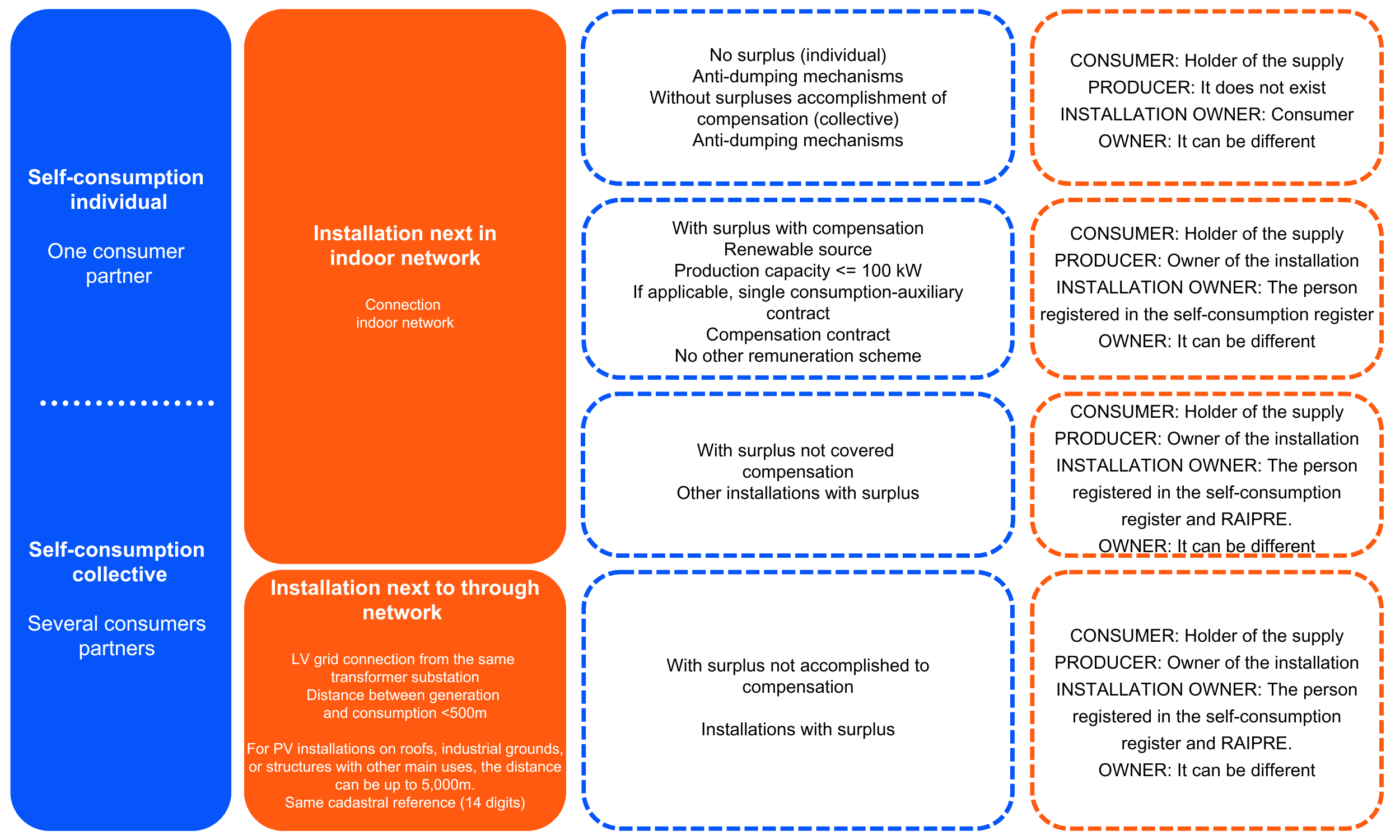
Self-consumption is the use of electrical energy generated at an installation close to the consumption point and linked to one or more consumers. It can be individual or collective.
Self-consumption modalities
Modality | What it means |
Self-consumption without surplus | The installation has a zero-export (anti-spill) system. Therefore, excess energy is not injected into the grid. |
Self-consumption with surplus | The installation can cover your consumption and, additionally, feed excess energy into the grid. |
How the installation can be connected
Type of connection | When it applies |
Nearby installation via internal network | When the installation is connected to the consumers' internal network or via direct lines. |
Nearby installation via the grid | When the installation is connected via the distribution network and meets any of these conditions: it belongs to the same low-voltage network as the transformer substation; if it is low voltage, the distance between generation and consumption is less than 2,000 m or 500 m, depending on the technology; or both fall under the same cadastral reference. |
The detailed regulations for these modalities and their requirements are set out in Royal Decree 244/2019. You can also consult the IDAE Guide to Self-Consumption Procedures.
(Source: Guía de Tramitación del Autoconsumo IDAE)
What procedures must you carry out with us?
If your installation is for self-consumption with surplus, these are the main procedures:
1. Request for access and connection
You must submit a generation access and connection request to us as the distribution company.
You do not need this procedure if your installation meets all these requirements:
You can submit the request in the private area of our website.
2. Response to the preliminary proposal
If you have requested access and connection, we will reply with:
3. Works on the distribution network
If you accept the technical and financial conditions, we will issue the access and connection permits and carry out the technical works necessary to connect your installation.
4. Technical Access Contract (CTA)
The Technical Access Contract (CTA) governs the technical relationship between us and you from the moment of connection. You can request it via the 'CTA Request' service in the private area.
If your installation does not require the access and connection procedure, you will not need to sign a CTA.
5. Metering configuration verification
Once the installation is finished and legalised, we must verify the metering configuration before connecting it to the grid.
You must request this verification by emailing: Inspeccionautoconsumo@enel.com.
This check is carried out in accordance with Royal Decree 1110/2007.
6. Certificates from the Meter Administrator and Grid Manager
If you need to register your installation as a producer, you must request the certificates stipulated in Article 39.1.d) of Royal Decree 413/2014 from us.
You can request them at: Conexiones.edistribucion@enel.com.
7. Updating the contract with your energy supplier
For your supply contract to reflect your chosen self-consumption modality, you must contact your energy supplier and request a contract update.
Once that contract has been adapted, the installation can enter into service.
If your installation generates a surplus, you can offset it on your bill when the power capacity is up to 100 kW, or sell it on the market, depending on the chosen modality.
Specific case: nearby installations via the distribution network
If your installation is nearby via the distribution network, requires a new connection point, has a production capacity of 15 kW or less, and is located on urbanised land with the amenities and services required by urban planning regulations, you must submit a request for us to assess and manage:
You will find all relevant information for the connection of self-consumption systems.
Yes. It is not limited to solar photovoltaic energy. It can also be applied to other technologies, such as wind or hydro.
We aim to respond as quickly as possible. Generally, the response time for installations of up to 100 kW is two weeks.
The cost depends on several factors, such as the size of the installation, the chosen technology, and the location. A professional installer can assess your case and recommend the best option.
No. The installation must be carried out by an authorised installer.
According to the Low Voltage Electrotechnical Regulations (REBT), they must be a specialist in low-voltage generation installations. Furthermore, for the installation to be legal, the installer must certify it and the distribution company must give its approval.
Only if your installation is registered under a self-consumption with surplus modality.
Installations without a surplus must have a zero-export (anti-spill) system installed. Therefore, they cannot inject energy into the grid.
Royal Decree 647/20 establishes several notifications prior to the effective commissioning of electricity generation modules.
The installation will be ready to operate normally once it is permanently registered in the RAIPEE registry, for which it must first obtain the operational notifications.
You have direct access from the private area of the e-distribution website by clicking here,
More > Services for producers > Operational notifications.
The Self-Consumption Code (CAU) uniquely identifies each self-consumption installation, as it links all the consumption and generation points associated with it.
It is a 26-digit code provided by the distribution company. It can be requested by the installer, the end customer, the developer, or any representative of the customer.
You will need the CAU for the following procedures:
You can request the CAU in the private area of our website by clicking here
Click here for a consultation using the form. And for optimal management of your needs, if it is a question of providing information/documentation of a file in progress or invoicing/bank transfers, please send your request by mail to conexiones.edistribucion@enel.com
You can request it via the CTA Request service in the private area. There is also a support guide available on the website.
You can do this through the TAC application (see attached guide).
More information and queries
If you have a general query about self-consumption, you can use the web form.
If you need to submit documentation for an ongoing application or discuss billing or bank transfer issues, you can email conexiones.edistribucion@enel.com.
Regulatory framework
If you need to validate the TXT file with the distribution coefficients, you can use the form available on the website.
The validator checks the file for formatting errors. It does not verify whether the CUPS are incorrect or non-existent.